Uttar Pradesh is building a digital database of its farmers, called the UP Farmer Registry, or UPFR, on the central government’s AgriStack platform. Each registered farmer gets a Farmer ID that links their identity with their land records. The state wants schemes such as PM-Kisan, crop insurance, subsidies and loan support to reach farmers through this one record.
This guide explains what the registry is, who it is meant for, what documents help, how registration works, how to check your status, and what is still unclear. It also separates what has been officially reported from what only third-party websites claim. The rules and deadlines for this registry have changed several times during 2026, so please confirm the latest instructions with the official portal or your local agriculture office before acting.
What Is the UP Farmer Registry?
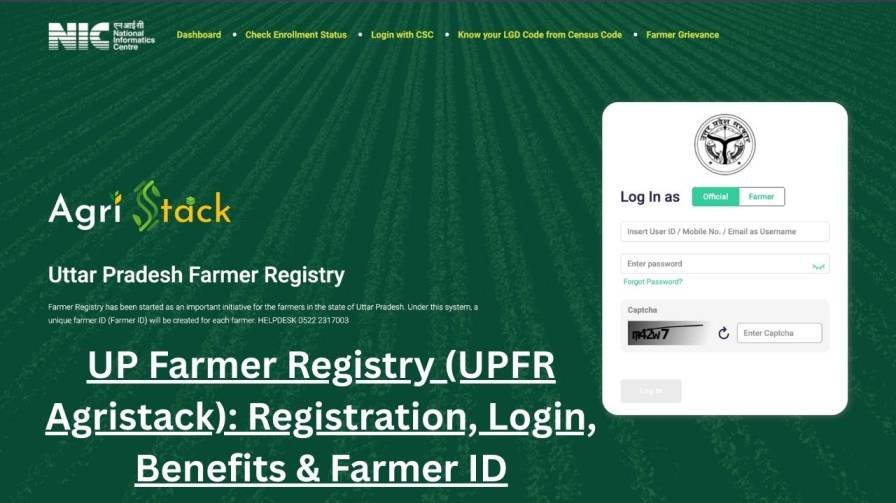
The UP Farmer Registry (UPFR AgriStack) is Uttar Pradesh’s state farmer database. It records a farmer’s name, Aadhaar-based identity and land parcels, and gives the farmer a unique Farmer ID. The official portal is upfr.agristack.gov.in. The state is using it as a single identity for agricultural schemes, so that benefits can be checked and delivered digitally.
UPFR AgriStack at a Glance
| Topic | Detail |
|---|---|
| Name | UP Farmer Registry (UPFR), part of AgriStack |
| Run by | Government of Uttar Pradesh, within the national AgriStack framework |
| Official portal | upfr.agristack.gov.in |
| Output | Farmer ID (Kisan Pehchan Patra) |
| Farmer ID format | 11 digits, described as 10 digits plus a check digit |
| Identity link | Aadhaar |
| Land link | State land records (khasra and khatauni details) |
| UP campaign launched | November 5, 2024 |
| UP target set by the Centre | 2,88,70,495 farmers |
| Latest UP figure found | 2,45,94,831 registered (85.19%) as of August 5, 2026 |
What the Registry Holds
According to a MicroSave explainer on AgriStack farmer registries, a state farmer registry holds a farmer's name, Aadhaar number, and the plot number and area of each land parcel the farmer owns in the state. The Farmer ID is a 10-digit number followed by a check digit, which makes 11 digits in total. Land parcels are linked to the farmer through state land records, and each plot receives a unique plot ID.
The same explainer notes that the registry currently covers land-owning farmers. Tenant farmers and sharecroppers are not covered yet, though governments have said they plan to add them. This matters for UP readers and is discussed again below.
Latest Registration Progress in Uttar Pradesh
Progress has been reported in news articles at different dates. The table shows the figures found, with their dates.
| Date of report | Reported position |
|---|---|
| August 21, 2025 | Over 1.45 crore farmers registered; special drive planned from September 16 (Patrika) |
| October 25, 2025 | About 54% registered, roughly 1.5 crore (Free Press Journal) |
| May 25, 2026 | 2.28 crore registered, 79.10% of the target; about 60 lakh pending (Free Press Journal) |
| August 5, 2026 | 2,45,94,831 registered, 85.19% of the target; about 42.75 lakh pending; UP ranked 10th nationally (Free Press Journal) |
Nationally, a news brief dated October 24, 2026 reported that the Digital Agriculture Mission had crossed 11 crore Farmer IDs, ahead of its March 31, 2027 deadline. We did not find a newer UP-specific figure than August 2026, so the latest percentage may be higher now.
Is the Farmer ID Mandatory in Uttar Pradesh?
This is the most common question, and the honest answer is that it depends on the scheme and the date. Reports during 2026 differ, so treat the table as a timeline and not as a single rule.
| Date of report | What was reported |
|---|---|
| January 1, 2025 | Farmer ID became mandatory for new PM-Kisan applicants in states including Uttar Pradesh (Krishi Jagran explainer) |
| April 1, 2026 | The Chief Minister directed registration of all farmers on a priority basis, with camps in every Gram Panchayat (All India Radio) |
| April 19, 2026 | Amar Ujala reported a plan to make the ID mandatory from June 1, with May 31 as the deadline to create IDs; it described this as a plan, not a final rule |
| April 20, 2026 | UP allowed farmers to sell wheat at MSP centres without registering, saying the registry was not mandatory for that purpose (Outlook India) |
| April 23, 2026 | Free Press Journal reported an April 30 target for full coverage and May 15 as the date when the ID would become mandatory for schemes, fertilisers and seeds |
Because these reports conflict, we cannot state one fixed deadline. The safest approach is to register early, keep your enrolment number, and check the latest notice on the official portal or with your district agriculture office.
Benefits of the UP Farmer ID
Official statements describe the registry as an integrated benefit system. The benefits reported include:
- One identity for many schemes. Schemes of the Agriculture Department and related departments are being linked to the registry.
- Direct delivery of benefits. The state names PM-Kisan Samman Nidhi, Fasal Bima (crop insurance), Krishi Anudan (agricultural subsidies) and loan facilities as examples.
- Better land record accuracy. The state's share-determination (Ansh Nirdharan) work, reported at 88.92% completion in August 2026, supports cleaner land records.
- Crop surveys. The registry supports digital crop surveys, such as the Zaid 2026 survey that was scheduled for May 2026.
- Possible faster verification for loans and insurance, since details are stored in one place. This is an expected benefit, not a guaranteed timeline.
Who Can Register?
Registration is aimed at farmers who hold agricultural land recorded in Uttar Pradesh's land records. In practice, you will need:
- An Aadhaar number, with a mobile number linked to it
- Land recorded in your name, with khasra and khatauni details
- A bank account, since scheme payments are made through banks
Tenant farmers and sharecroppers. Some third-party guides say tenants can register with a lease agreement. We could not confirm this from an official source, and the MicroSave explainer says tenants are not covered yet. If you are a tenant, ask your local agriculture office whether any tenant process is active before you spend time on an application.
Land in joint or inherited names. Land records must match Aadhaar details. If a record is out of date or the name is spelled differently, correct the record at the local tehsil or through the proper revenue process first.
Documents That Help
| Document | Why it is needed |
|---|---|
| Aadhaar card | Identity check and link to your Farmer ID |
| Aadhaar-linked mobile number | Receiving the one-time password (OTP) |
| Land record (khasra and khatauni) | Linking your land parcels to your ID |
| Bank passbook | Bank details for scheme payments |
| Recent photograph | Often asked at camps or CSCs |
Some websites list extra documents, such as a caste certificate. We did not find an official source for that, so carry it only if a scheme you apply for separately asks for it.
How to Register
Route 1: Village camp or agriculture office. The state has run registration camps in villages and Gram Panchayats, and field staff have been asked to verify farmers who are still unregistered. This is a good route if you have no internet access or your land record needs correction. Bring your original documents.
Route 2: Self-registration on the portal. Third-party guides describe the online steps as follows. Screens can change, so follow what the official portal shows.
| Step | Action |
|---|---|
| 1 | Open upfr.agristack.gov.in and choose the farmer option for new registration |
| 2 | Enter your Aadhaar number and verify the OTP sent to your linked mobile |
| 3 | Check the details fetched, and fill in any missing ones |
| 4 | Provide or confirm land details and bank details |
| 5 | Upload documents if the portal asks for them |
| 6 | Submit, and save the enrolment or acknowledgment number |
A Common Service Centre (CSC) operator can also help with registration. We did not find an official fee for this, so ask for the rate before you pay, and do not pay anyone who promises to "speed up" approval.
How Verification Works
After you apply, officials check your details. In the AgriStack design described by MicroSave, a name-match score compares the name in your Aadhaar with the name in the land record. High scores can be approved automatically, medium scores need manual checking, and low scores need correction first. Applications that are not auto-approved go for field verification. This is why matching names across records matters so much.
How to Check Application Status and Log In
- Open the official portal and use the enrolment status option.
- Search with your enrolment number or Aadhaar number, as the portal allows.
- Verify with the OTP if asked.
- Read the status shown, which may be pending, approved, rejected or "document required".
Third-party websites mention a processing time of 7 to 15 working days, but no official source confirmed this. Do not rely on a fixed number of days. If your status stays unchanged for a long time, visit your village camp, lekhpal or district agriculture office with your enrolment number.
To log in after approval, use the farmer login on the portal with your Aadhaar-linked mobile number and the OTP.
Common Problems and What to Do
Problem | What to try |
|---|---|
| OTP not received | Check that your mobile is linked to Aadhaar; update it at an Aadhaar centre if not |
| Name mismatch | Correct the Aadhaar or the land record so both show the same name |
| Land not showing | Ask the local revenue office to check your record and any pending share-determination work |
| Application rejected | Read the reason, correct the issue and reapply or approach the camp |
| Tenant farmer unsure | Ask the district agriculture office about the current rule |
| Agent asks for money | Do not pay for approval; use camps, the portal or an authorised CSC |
Frequently Asked Questions
1. What is UPFR AgriStack? It is the Uttar Pradesh Farmer Registry on the AgriStack platform, a state database that gives each farmer a Farmer ID linked to Aadhaar and land records.
2. What is the official website? The official portal is upfr.agristack.gov.in.
3. How many digits does the Farmer ID have? A MicroSave explainer describes it as 10 digits plus a check digit, or 11 digits in total. Some third-party pages say 12; we could not confirm that.
4. Is the Farmer ID mandatory in UP? It is mandatory for new PM-Kisan applicants since January 1, 2025, and the state has announced several dates for wider use in 2026. In April 2026, UP allowed wheat sales at MSP centres without it. Check the latest notice for your scheme.
5. How many UP farmers have registered? As of August 5, 2026, 2,45,94,831 farmers, or 85.19% of the target of 2,88,70,495, according to a Free Press Journal report.
6. Can tenant farmers register? Official confirmation is lacking. One explainer says tenants are not yet covered, while some third-party guides say a lease agreement can be used. Ask your agriculture office.
7. What documents do I need? Aadhaar, an Aadhaar-linked mobile number, land records, bank details and a photograph are the usual documents.
8. Is there a fee? We did not find an official registration fee. If a CSC charges a service fee, ask for the rate first and keep the receipt.
9. How do I check my status? Use the enrolment status option on the official portal with your enrolment or Aadhaar number.
10. What if my name does not match my land record? Correct the Aadhaar or land record first, because the registry compares the two.